Un viaje histórico y cultural por Montevideo
There are places you just can’t miss if you visit Montevideo. Exploring its Old Town on foot or by bike will surprise you: you’ll find cultural, culinary, and architectural diversity at its finest.
Montevideo, once a fortified city, bears witness to its historical evolution dating back to the 18th century. Come discover the stories held within the historic heart of the Uruguayan capital.
Independence Square and Surroundings
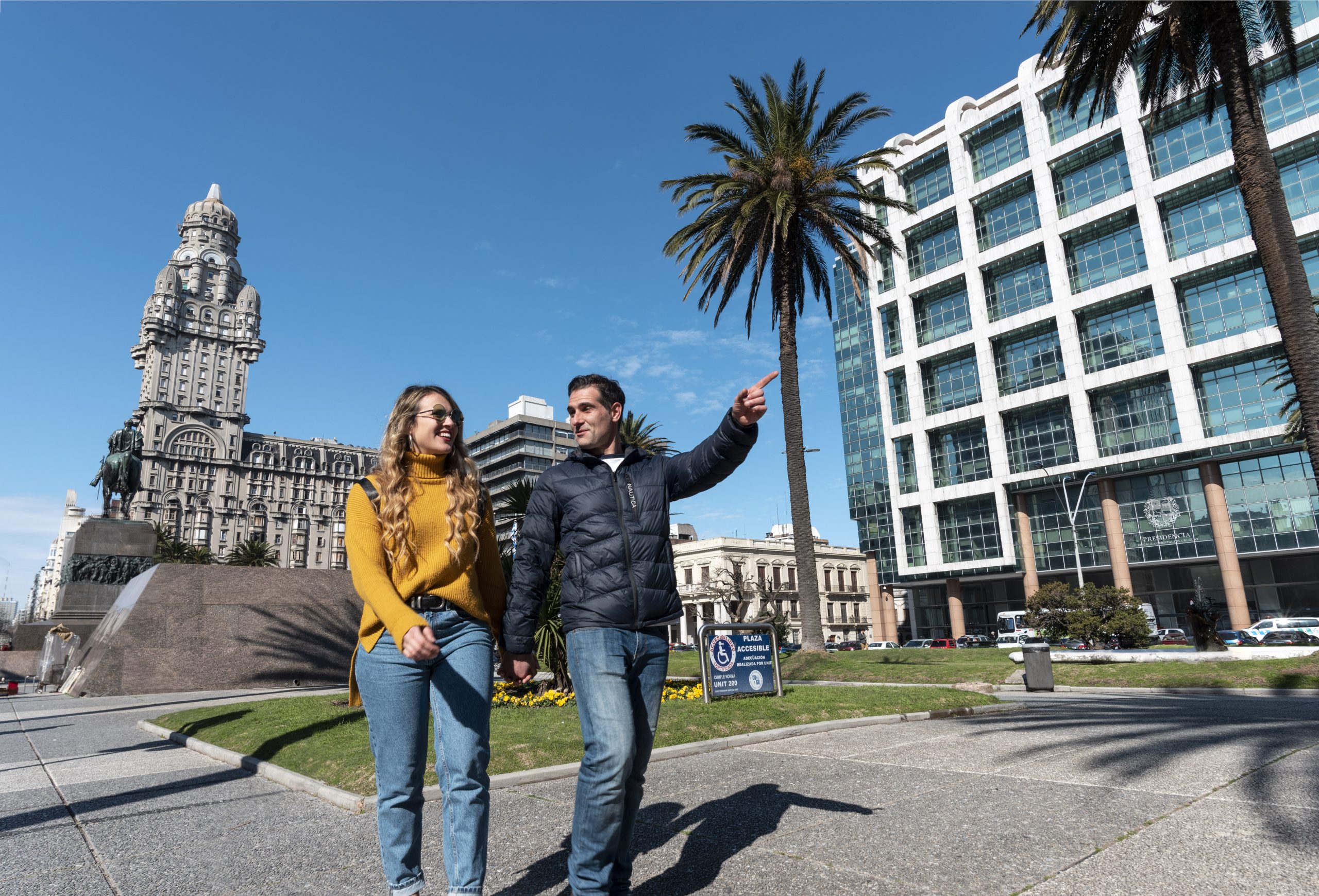
The most iconic square in Montevideo marks the boundary between the colonial-era walled Old City and the open, modern New City. At its center stands the monument to national hero José Gervasio Artigas, beneath which lies his mausoleum. The square is surrounded by historic buildings such as Palacio Salvo, Palacio Estévez, and Teatro Solís, all worth visiting for their architectural and cultural value.
Teatro Solís, first opened in 1856, is the oldest theater in Uruguay and one of the most prestigious in Latin America. It offers guided tours and a wide range of artistic performances.
At one end of the square stands the Citadel Gate, one of the last remnants of Montevideo’s original fort. Just across the street begins Sarandí Pedestrian Street, where you’ll find Torres García Museum, dedicated to the work of the renowned Uruguayan artist.
A few steps away, and perfect for enjoying a coffee while choosing a good book, is Más Puro Verso, a bookstore that dazzles with its eclectic 1917 architecture, featuring Art Nouveau influences and French styles that were trending at the time.
Three blocks down Sarandí, you’ll reach the Metropolitan Cathedral and Constitution Square, next to the old Cabildo building. These landmarks still preserve their charm and reflect their historical significance.
Starting Point: Av. 18 de Julio & Independence Square
Zabala Square
Inaugurated in 1890, Zabala Square is one of the most picturesque in the city, with its European landscape design and an equestrian statue of Bruno Mauricio de Zabala, founder of Montevideo.
Its unique layout, rotated relative to the traditional street grid, reflects the Belle Époque spirit that once aimed to make Montevideo resemble Paris. This vision led to the creation of the Parks Department in 1889, which commissioned the project to French landscape architect Édouard André.
Other elements add to its uniqueness, including a defined perimeter fence, winding paths bordering flower beds and grassy areas, and Gothic-style features like street lights, a drinking fountain, and an octagonal gate.
Location: Circunvalación Durango
Taranco Palace
Once the residence of the Ortiz de Taranco family, this building now houses the Museum of Decorative Arts, featuring a valuable collection of furniture, tapestry, classical archaeology, and artwork.
It was built in the early 20th century (1907) on the site of the city’s first Comedy Theater. In 1943, it was donated to the state along with its art collection.
The building was designed by renowned French architects Charles-Louis Girault and Jules-Léon Chifflot, known for works such as the Petit Palais in Paris and the Arc de Triomphe in Brussels.
Location: 25 de Mayo 376 & Solís
Opening hours: Tuesday to Saturday, 11:00 a.m. – 6:00 p.m.
Admission: Free / Fee for non-residents
Birthplace of Artigas
A site of great symbolic value, located where the Artigas family lived from their arrival in Montevideo Bay until the 1830s—and where José Artigas was born.
It is now a space for exhibitions and educational outreach, offering insights not only into the life of Artigas but also into Montevideo’s everyday life across nearly its entire urban history.
It also features a multifunctional space for small conferences or temporary exhibitions.
Location: Colón 1501 & Cerrito
Hours: Mon–Fri 10:00 a.m. – 4:00 p.m. / Sat 9:00 a.m. – 3:00 p.m.
Admission: Free
Gaucho and Numismatics Museum
The perfect way to end your tour through Montevideo’s oldest district. Through two collections, you’ll explore the figure of the gaucho, from wanderer to national hero, and discover the evolution of Uruguay’s currency. Over 600 items are on display.
Five rooms are dedicated to the gaucho, tracing their origins, lifestyle, activities, customs, and clothing, with artifacts made from leather, wood, iron, and stone. The exhibit follows the gaucho’s transformation, highlighting their role as a soldier in national struggles from 1811 to 1904, following and backing political leaders and wearing either white or red party badges.
In the former bank vaults, you’ll find a numismatic journey from colonial times to the founding of the National Bank in 1896, Uruguay’s first state bank.
On display are Portuguese and Spanish colonial coins, including ones recovered from the 1752 shipwreck of the Nuestra Señora de la Luz, as well as Uruguay’s earliest coins, such as the Peso del Sitio, the first silver coin minted during the Siege of Montevideo in 1844. It was declared a Historic Heritage item in 2019. The paper currency exhibit features bills from early exchange houses and private banks, ending with a bill issued by the National Bank in 1896.
Location: Cerrito 351 & Zabala
Opening hours: Mon–Sat 10:00 a.m. – 6:00 p.m.
Admission: Free
Montevideo will captivate you with its history and culture. End your day at Café La Farmacia (550 Cerrito St.), the perfect spot to enjoy a coffee and great company. Another must see is the Port Market (Mercado del Puerto, at 237 Piedras St.), an iconic site inaugurated in 1868 that once housed the old food market.
The star here is the traditional barbecue, but you’ll also find fish, seafood, empanadas [pasties], and craft beer, not to mention original souvenirs to take home.