Uruguay has at least five reasons why you can’t miss it if your passion is nature and its biodiversity, as recommended by biologist Adrián Azpiroz. Take note!
1) Small country, short distances
“Uruguay is a small country with many birds (480 species recorded, with 2-3 new additions, on average, each year). This country is home to almost 50% of the species found in Argentina and 25% of those found in Brazil, in an area that is 15 and 48 times smaller, respectively.
Thanks to the excellent road network, most corners of the country can be reached in a few hours. This means less time in the car and more time birding. The possibility of visiting many habitats in just a few hours usually produces extensive species lists (more than 120 in a day).
2) “Uruguay Natural”
Here are some of the best-preserved expanses of native grasslands in the entire Pampas biome (which extends from eastern Argentina to the southern tip of Brazil). The “Uruguay Natural” country brand promotes a wide diversity of products and services, from tourism to agriculture. Although much more effort is needed to achieve high standards of nature conservation, Uruguay’s landscapes still harbor important populations of wild birds.
3) Strategic Location: Pampas, Chaco, Atlantic Forest Birds and more…
Southeastern South America, the region where Uruguay is located, is a transition zone separating tropical and temperate areas, to the north and south, respectively. Here, the Pampas biome (with native grasslands as its main ecosystem) is mixed with various forest types, including those with affinities to the Chaco and Atlantic Forest.
Migratory birds from distant regions enrich the local avifauna. During the winter, southern visitors (albatrosses, petrels and different species of birds) bring a Patagonian / sub-Antarctic touch to the aquatic and grassland environments, while boreal migrants (mainly seabirds) add richness during spring and summer.
4) Many types of habitats: grasslands, forests, mountain ranges, sandy beaches …
To the diversity of the biome is added a great variety of ecosystems, which provides an important heterogeneity of habitats for birds and wildlife in general. In addition to grasslands and forests, the Uruguayan territory includes a great variety of streams and rivers, more than 500 km (300 miles) of coastline along the estuary of the Plata River and the Atlantic Ocean, more than 50 islands, mountain ranges, alluvial plains, brackish coastal lagoons, ravine forests, etc. Each ecosystem includes a characteristic group of birds. The environments of open physiognomy, such as wetlands and grasslands, represent a characteristic feature of the Uruguayan landscape, which facilitates the detection and observation of wild birds.
5) Pampas endemics and globally threatened birds
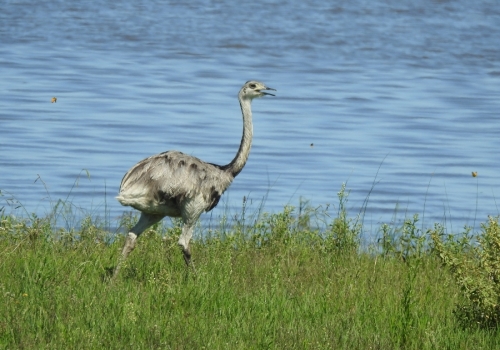
Most of the birds endemic to the Pampas biome can be easily found in Uruguay. This is also true for many globally threatened and near-threatened birds*. For example, the Rhea (NT), the Southern Flamingo (NT), the Magellanic Penguin (NT), the White-bearded Petrel (VU), the Black-crowned Gull, the Dwarf Woodpecker (NT), the Straight-billed Woodpecker (NT), the Curved-billed Woodpecker (NT), the Curved-billed Curassow, the Ochraceous Curutié, the Great White Widow (VU), the Dragon (VU), the Brown-throated Capuchin (NT) and the Gray-crowned Capuchin (VU), are all quite common in Uruguay.
Other rarer species can be found at particular sites: Red Knot (NT), Cinnamon-bellied Sandpiper (NT), Dwarf Sparrowhawk (VU), Yellow-cardinal, White-breasted Capuchin (EN) and Pampas Warbler (VU). Even less predictable birds such as Cinnamon-rumped Tachuri (NT), Blue Magpie (NT), and Golden-crested Hornbill (VU) are frequently encountered during birding excursions.”
*Note: According to the International Union for Conservation of Nature (IUCN) species at risk of extinction are classified in a series of categories: “NT” = Near Threatened; “VU” = Vulnerable; and “EN” = Endangered.
Photos: Wild Punta del Este , Adrián Azpiroz.